
An AI CRM uses artificial intelligence to capture, sort, or suggest sales work. For freight forwarders, the most useful AI is in capture—turning a voice note or an RFQ email into a structured record. The daily call queue, however, works best on visible cadence rules that your managers set and your team can see. This is the honest picture of how an ai sales crm should work for you.
Most platforms promise a magic score. We believe the real problem isn't knowing who to call; it's making sure every enquiry gets a first touch and every deal gets its follow-up. That’s a cadence problem, and it’s too important to hide in a black box. This is a core part of the complete guide to freight sales CRM, focusing on where AI earns its keep and where it needs to stay out of the way.
What 'AI CRM' usually means
When you see the term "AI CRM," it typically refers to a platform with one or more of four common AI-driven features. These are designed to assist sales teams, but it's crucial to understand what each one actually does in practice.
1. Data Capture and Extraction
This is the most common and, for freight, the most practical use of AI. The system reads unstructured information—like an email, a PDF attachment, or a transcribed voice note—and pulls out structured data. It turns a free-text message about a shipment from Nhava Sheva to Felixstowe into distinct fields for origin, destination, and mode of transport. The goal is to reduce manual data entry.
2. Predictive Lead Scoring
This feature uses a machine-learning model to analyze historical data and assign a score (e.g., 1-100) to a lead or opportunity. The score represents the estimated likelihood of that deal closing. It might consider factors like the shipper's industry, past win rate, or email engagement. The idea is to help reps prioritize their day by focusing on the "hottest" leads.
3. AI-Drafted Communications
Generative AI can create draft emails or messages for salespeople. Based on the context of the deal, the last customer interaction, and a prompt from the rep, the AI will compose a follow-up, an acknowledgement, or a request for more information. The output is a draft that the salesperson must review, edit, and approve before sending.
4. Conversation Analysis
For teams that record their calls, AI can transcribe the audio, summarize the conversation, identify action items, and even detect customer sentiment or specific keywords mentioned (like a competitor's name). This helps with coaching and ensures that promises made on a call are captured as tasks in the CRM.
What freight sales actually needs
The generic pitch for an AI CRM often misses the specific, time-sensitive realities of a freight forwarder's sales desk. Your challenges aren't theoretical; they are operational, and they happen fast.
A Fast First Touch on Every Enquiry
Enquiries arrive by email at all hours, often with incomplete information. The clock is ticking. Every minute an RFQ sits unanswered in a shared inbox is a minute your competitor is using to win the business. You need a system that assigns an owner and starts the clock on the five-minute rule instantly.
Field Sales Visits Logged as Actionable Data
Your field salespeople are your eyes and ears at a customer's warehouse or a port like Jebel Ali. But their visit notes, often jotted down late at night or not at all, rarely make it into the CRM in a useful way. A good system must make it effortless to turn a quick voice note into a structured record with a clear next step.
Fewer Deals Lost to Missed Follow-ups
Pipelines do not hunt. In our experience, most deals in freight forwarding are not lost because a rep called the wrong account. They are lost because a follow-up was missed, a quote was sent and forgotten, or an opportunity went cold from simple neglect. The biggest need is not a perfect prediction of who will buy, but a relentless cadence that ensures every promising deal is worked systematically.
A Clear Handoff to a Quote Request
The natural next step after a good sales conversation is a quote request. This isn't just another "activity"; it's a handoff to your pricing or operations team. The request needs to be structured and complete, with all the necessary details—commodity, weight, dimensions, Incoterms—to get a fast, accurate rate from a carrier or overseas partner.
Where the AI works in SalesCRM AI
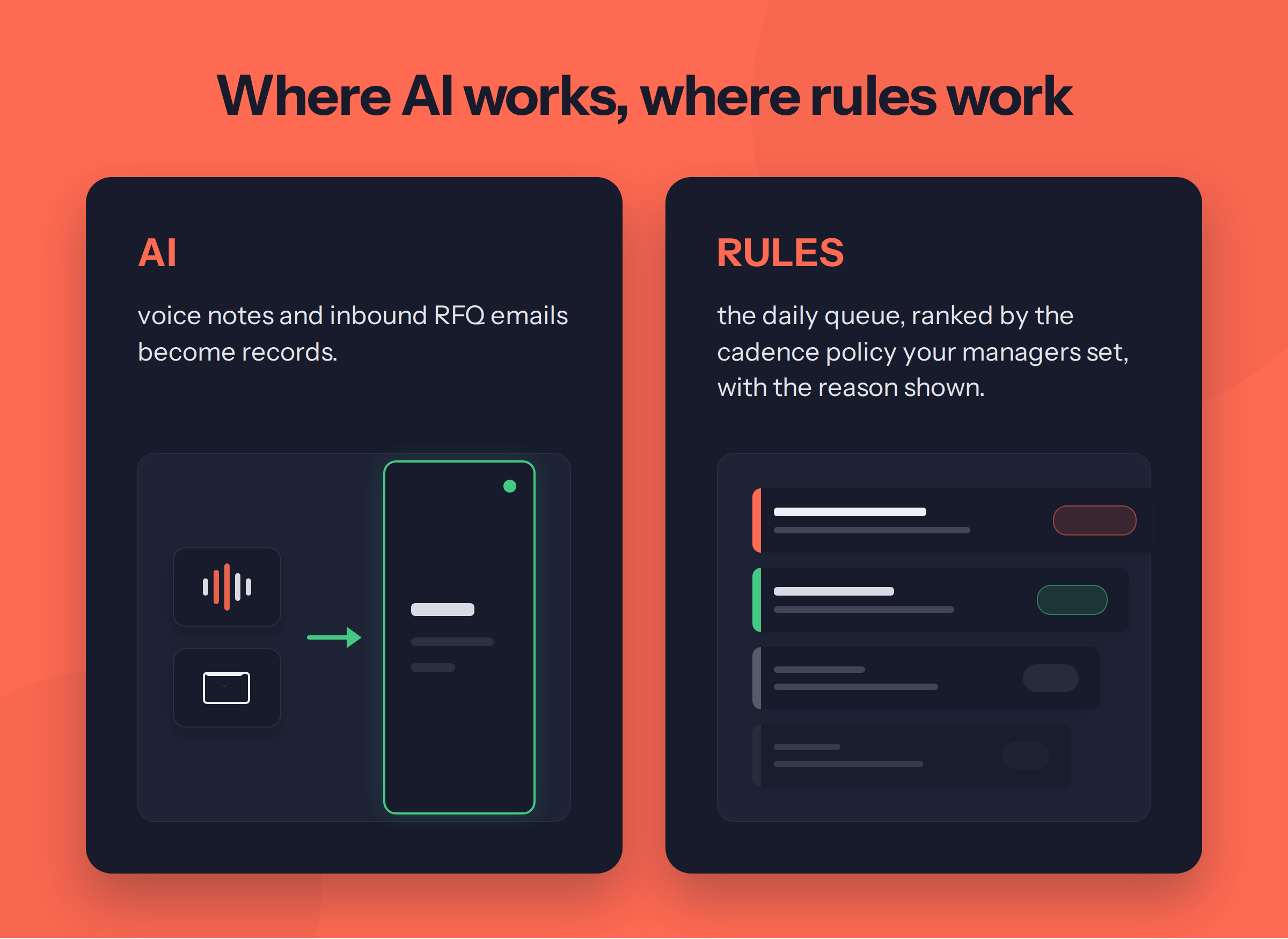
We believe AI should do the work you hate, not the work you need to control. In SalesCRM AI, that means using AI for capture—where typing is the bottleneck—so your team can focus on selling.
From Voice Note to CRM Record
Your salesperson leaves a customer visit. They record a quick voice note: "Just met the logistics head at the electronics importer; they need a quote for two 40-footers from Mundra to Los Angeles, cargo ready next week. Need rates by Thursday."
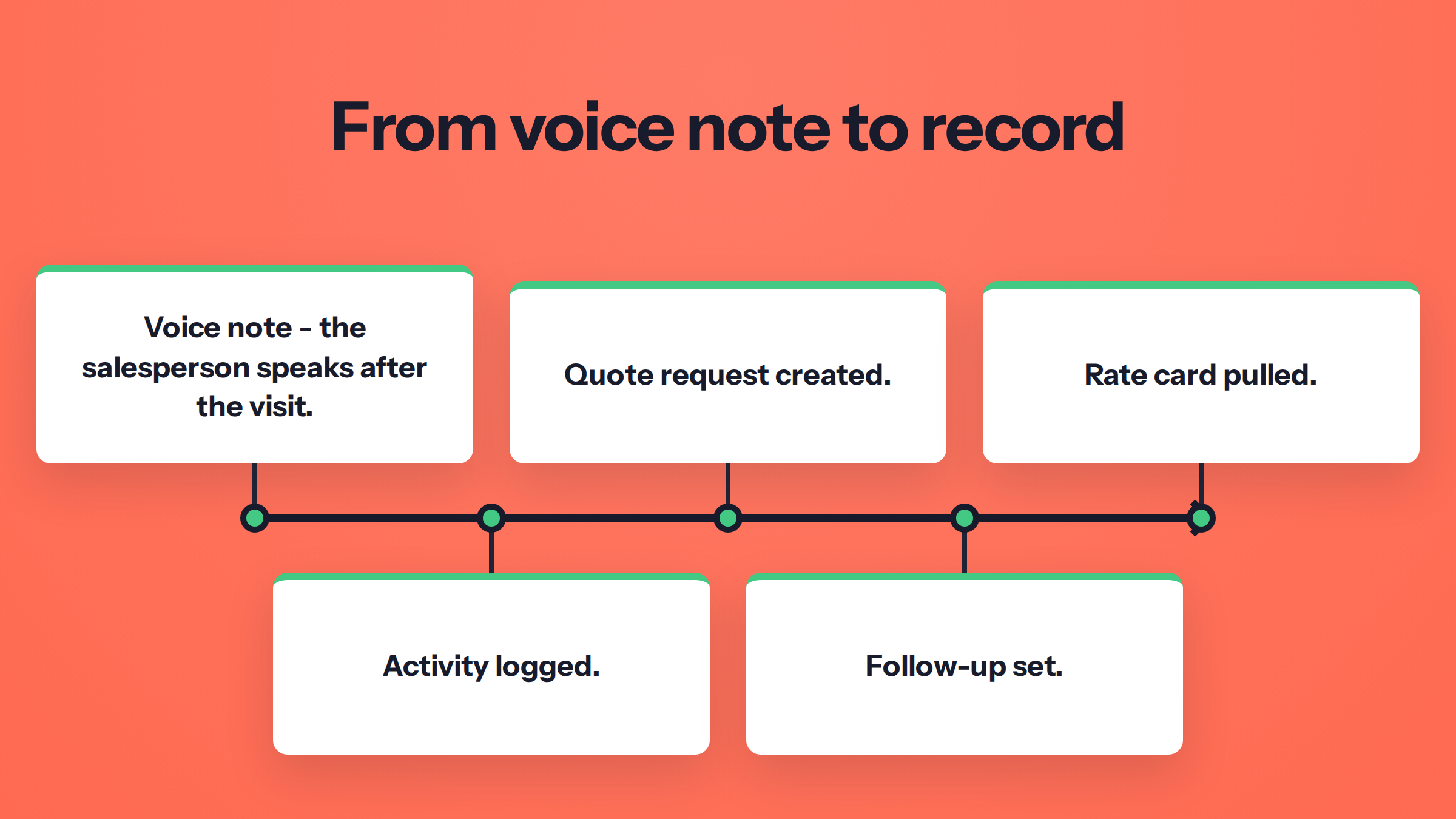
SalesCRM AI turns that voice note into the record. Our system:
- Logs the visit activity against the importer’s account.
- Creates a new quote request with the origin, destination, and equipment details.
- Sets a follow-up task for the salesperson, due Thursday.
- Pulls the rate card.
This is the power of a true voice CRM for freight sales teams. The activity is logged, and the work is created, all from a single voice note. No typing, no forgetting, no late-night admin.
From Inbound RFQ to Owned Pipeline Card
An RFQ lands in your company's sales inbox. Instead of waiting for someone to see it, read it, and manually create a deal, SalesCRM AI turns the email into a card in your pipeline.
Crucially, that card already has an owner, and the first-touch clock is already running. An unstructured email becomes a piece of work that is visible and owned before anyone has read the inbox.
From Won Deal to Onboarded Customer
Winning the deal is not the finish line; the customer still has to be set up before the first shipment can be invoiced. SalesCRM AI onboards a new customer from their own documents: AI fills the onboarding and KYC form from what the customer sends, and whatever is still missing goes to the customer as a link they can complete without logging in. No chasing for forms, and no re-typing company details that are already on the documents.
Why the queue stays rule-based
While AI is great for capture, we believe the daily sales queue—the list that tells your reps who to call next—must be driven by transparent, deterministic rules that you control. A black-box score is hard to coach and impossible to argue with.
The Focus Engine Ranks Your Day by Your Rules
The SalesCRM AI Focus Engine ranks each rep's daily task list not by a secret algorithm, but by your company's own sales cadence. You decide what's most important. The ranking is typically ordered by urgency:
- Never-contacted leads still inside their first-touch window.
- Overdue follow-ups where a promised action is late.
- Deals going cold that haven't had activity for a set number of days.
- Deals closing soon where a decision date is approaching.
This is a system built for action, not just analysis. You can see exactly how it works to drive your team's daily rhythm.
Visible Rules for Clear Accountability
Behind every single item at the top of the queue is a visible reason: “First-touch window closes today,” or "Follow-up is 3 days overdue." A salesperson can see exactly why they need to act, and a sales manager can coach to that specific reason. If you want to change the priority—for example, a shorter first-touch window or fewer days before a deal counts as cold, you change the rule. This matches how sales managers already think and coach their teams.
The Overnight WhatsApp Brief
To make this even more direct, SalesCRM AI prepares the day's brief overnight and sends it on WhatsApp. A salesperson wakes up and sees their first few calls and most urgent tasks right on their phone, with drafts ready for review. They can start their day with momentum, without logging in.
What SalesCRM AI does not do
Being clear about what our AI CRM doesn't do is as important as explaining what it does. These are deliberate design choices to keep your team in control.
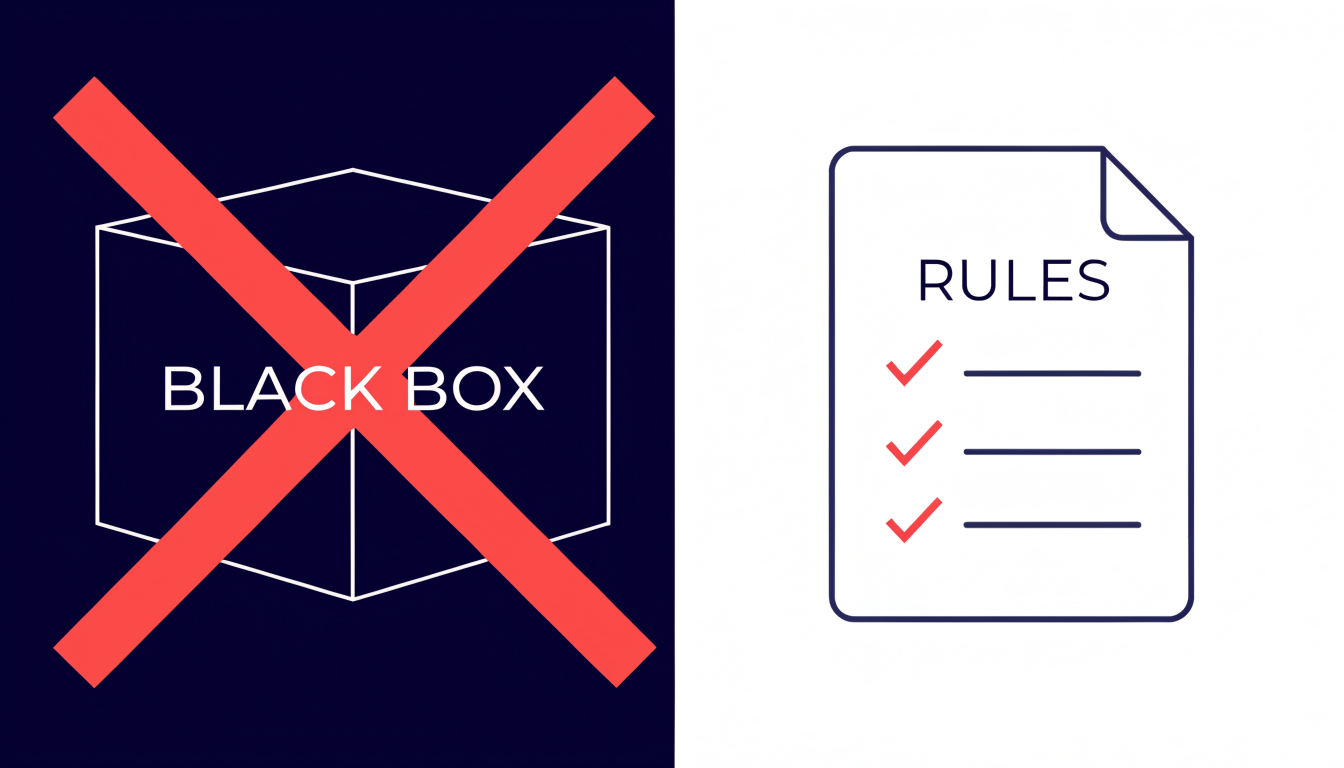
- No machine-learning lead scoring. We don't generate a "black box" score. Your queue is ranked by the visible cadence rules your managers set.
- No AI sending to customers. The overnight brief includes drafts for the salesperson to read, but every message a customer sees waits for a person on your team.
- No telephony or call recording. We are not a phone system. Your team continues to use their existing phones, Microsoft Teams, or other communication tools.
- No installable phone app. Your team doesn't need to install anything from an app store. The overnight brief arrives on WhatsApp.
How to evaluate an AI CRM for freight
When you're looking at an ai crm for sales, you need to cut through the hype and ask questions that matter to your forwarding business.
Ask What, Exactly, the AI Does
Demand feature-by-feature specifics. Does it just summarize, or does it create structured data? If it scores leads, can you see the logic? Don't settle for vague promises of "intelligence."
Check if You Can See and Change the Rules
Your sales process is your intellectual property. Can you configure the rules that drive the daily queue? Or are you locked into the vendor's secret sauce? A system that adapts to your cadence is always better than one that forces you to adapt to its algorithm.
Ensure a Won Deal Connects to Operations
The single most important test: what happens when a deal is marked "won"? Does it seamlessly become an account on the same platform that runs quotes, jobs, and invoices, and how much of the customer onboarding does your team still have to do by hand? Or does your operations team have to re-key everything into a separate TMS? The gap between sales and operations is where profit leaks and mistakes happen. You can see the difference in our comparisons of a freight CRM compared with a generic CRM and a forwarder CRM compared with a freight broker CRM.
For a broader view on how AI is impacting the entire industry, from documentation to execution, you can also explore this guide to AI across the forwarding platform.
Ready to see how a rule-based queue can bring discipline and momentum to your sales team? See it on your own data. See your queue ranked live.
Frequently Asked Questions
What is an AI CRM?
An AI CRM is a Customer Relationship Management system that uses artificial intelligence features to help sales teams. In practice, this usually means AI assists with tasks like capturing data from emails, transcribing voice notes, drafting follow-up messages, or suggesting which leads to prioritize. For freight forwarders, the most valuable function is often data capture, which reduces manual admin work.
Does SalesCRM AI score leads with machine learning?
No. We made a deliberate choice not to use a "black box" machine-learning score. Instead, the SalesCRM AI queue is ranked by visible, deterministic cadence rules that you and your sales managers set. This ensures everyone knows why a task is a priority (e.g., "first-touch window ending") and allows you to control your sales process directly.
Can salespeople log activity by voice?
Yes. This is a core feature. A salesperson records a voice note after a call or visit, and SalesCRM AI turns it into the record: the activity is logged, the quote request created, the follow-up set and the rate card pulled. It turns unstructured conversation into structured, actionable data without manual typing.
Does the AI write and send emails to customers?
No. The overnight brief includes drafts for the salesperson to read, but nothing goes to a customer until a person on your team sends it.
From reading to hunting.
Everything on this page runs live on a working board — queue, cadence, quotes, wallet share. Bring your pipeline and watch Monday morning rank itself.
Book the working sessionKEEP READING